
 简体中文
简体中文 English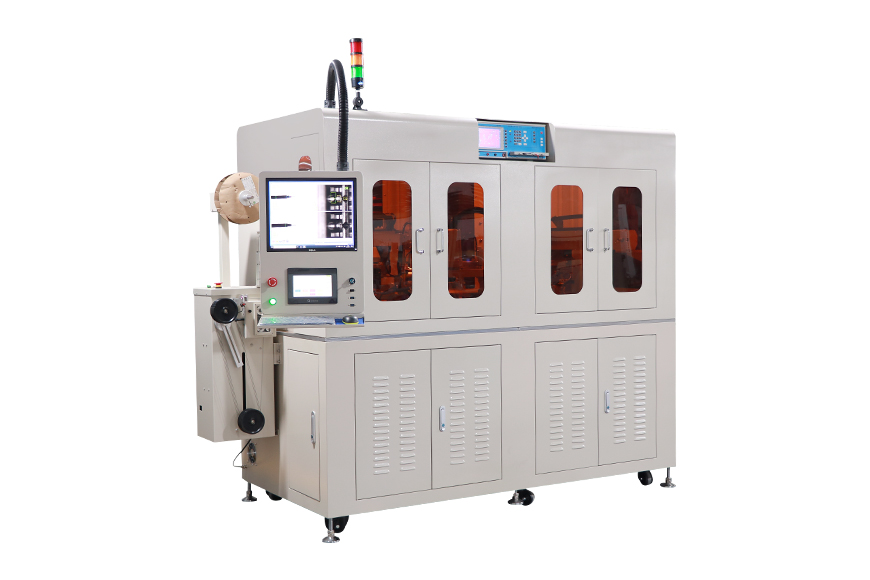
Full-Automatic Coaxial Cable End-Terminating and Tin-Plating Machine DM-N0708
Product Overview
The full-automatic coaxial cable end-terminating and tin-plating machine DM-N0708 is an integrated intelligent device specifically designed for coaxial cable processing. Compared to its predecessor, model B0706, it adds a practical core-wire twisting function, further enhancing its ability to cover the entire coaxial cable processing workflow. This equipment integrates a precision coaxial wire stripper, robotic systems, and high-resolution vision technology, enabling a complete processing sequence that includes core-wire twisting, automatic crimping, automated testing, automatic flux application, and automatic tinning. It also features automatic collection of both finished and defective products, providing efficient and precise coaxial cable solutions for the consumer electronics and telecommunications equipment manufacturing industries.
Core Function Upgrades
Compared to the basic model B0706, the most significant upgrade in DM-N0708 is the addition of the core-wire twisting function. During coaxial cable processing, loose core wires can lead to poor contact and uneven tinning in subsequent crimping and tinning steps. Traditional processing methods require an additional twisting step, which not only increases labor costs but also extends the production cycle. The DM-N0708’s core-wire twisting function allows for direct, orderly twisting of the core wires immediately after stripping, ensuring tight alignment and providing a stable foundation for subsequent processes—eliminating the need for separate twisting equipment, simplifying the production flow, and boosting overall processing efficiency.
Integrated Processing Workflow Analysis
As a fully automated end-to-end device, the DM-N0708 consolidates multiple critical steps of coaxial cable processing into a single machine, achieving unmanned operation from raw material input to finished product output. First, the precision coaxial wire stripper accurately removes the outer insulation, shielding layer, and inner insulation according to preset parameters, ensuring precise dimensions without damaging the core wire. Next, the newly added core-wire twisting function neatly twists the loosened core wires. Then, robotic components transfer the processed coaxial cables to the crimping station, completing the automated crimping process to ensure a secure connection between the terminal and the core wire. Following crimping, the machine automatically performs electrical performance tests on the connections, identifying issues such as poor contact or abnormal resistance. Qualified products proceed to the tinning stage, where they are automatically coated with flux and tinned, improving conductivity and oxidation resistance. Finally, the sorting system separates finished products from defective ones, realizing full automation across processing, inspection, and sorting, significantly reducing manual intervention while enhancing processing accuracy and production efficiency.
Core Technical Support
The stable operation of the DM-N0708 relies on three core technologies: precision coaxial wire stripping, robotic positioning, and high-resolution vision. Precision coaxial wire stripping ensures accurate removal of insulation layers for various cable specifications, keeping stripping errors within extremely tight tolerances to prevent damage to the core wire or incomplete stripping. Robotic positioning guarantees precise and efficient material transfer between processes, with high repeat positioning accuracy to maintain continuity throughout the workflow. High-resolution vision technology is employed during inspection, precisely detecting details such as core-wire twist quality, crimping integrity, and solder surface smoothness, promptly identifying defects and ensuring high-quality finished products. The coordinated synergy of these three technologies gives the machine exceptional precision and stability, meeting the stringent requirements of high-end electronics manufacturing.
Key Advantages
1. Full-process integration: Combining stripping, twisting, crimping, testing, tinning, and sorting into a single machine eliminates the need for multiple devices, saving workshop space and streamlining production management.
2. Added core-wire twisting function: Addresses processing defects caused by loose core wires, improving the quality and stability of subsequent crimping and tinning processes, thereby reducing defect rates.
3. High level of automation: From raw material input to finished product sorting, the entire process is fully automated, significantly cutting labor costs while minimizing human error.
4. High-precision processing: Supported by precision stripping and visual inspection technologies, each step maintains strict accuracy, ensuring excellent electrical performance and aesthetic quality of finished products.
5. Intelligent sorting and collection: Automatically distinguishes between finished and defective products, facilitating subsequent storage of good items and rework of defective ones, thus enhancing production management efficiency.
Core Product Value
1. Simplified production workflow: With its integrated design, the machine reduces equipment investment and workshop space requirements, lowering overall complexity of production management.
2. Enhanced processing quality: The new core-wire twisting function and visual inspection technology effectively reduce defective products, increase yield rates, and cut rework costs.
3. Improved production efficiency: Fully automated operation dramatically boosts productivity compared to traditional manual methods combined with single-process equipment, shortening product delivery cycles.
4. Reduced total cost of ownership: By decreasing labor inputs, lowering defect rates, and increasing equipment utilization, the machine helps enterprises cut overall production costs from multiple angles.
Target Customer Groups
Consumer electronics manufacturers, telecommunications equipment producers, coaxial cable component processors, electronic contract manufacturers, and high-end wiring harness producers—especially large-scale enterprises with demanding requirements for coaxial cable processing accuracy and production efficiency.
Application Scenarios
This equipment is primarily used in coaxial cable processing applications within the consumer electronics and telecommunications sectors, including smartphone charging cables, headphone cables, internal coaxial cable assemblies for tablets and laptops, signal transmission lines for communication base stations, coaxial cable harnesses for routers and switches, and miniature coaxial cable processing for smart wearable devices. In these scenarios, the machine efficiently completes the entire coaxial cable processing workflow, meeting stringent demands for electrical performance and stability.
Solving Industry Pain Points
1. Addressing the issues of fragmented equipment, cumbersome workflows, and low production efficiency inherent in traditional multi-step processing models by implementing full-process automation through an integrated design, thereby significantly boosting productivity.
2. Improving precision and consistency in manual twisting and crimping operations through automation and visual inspection, ensuring uniform quality and reliability.
3. Overcoming the inefficiencies and error-prone nature of manual sorting of defective products by introducing automated sorting and collection functions, enabling precise identification and separation of defects and enhancing production management efficiency.
4. Reducing enterprise costs related to equipment procurement, workshop layout, and labor inputs by replacing multiple single-process machines with a single unit, minimizing resource consumption and improving economic returns.
Frequently Asked Questions (FAQ)
Q1: What are the main functional upgrades of the DM-N0708 compared to the B0706?
A: Compared to the B0706, the DM-N0708 adds a core-wire twisting function, allowing direct twisting of the core wire after stripping, preventing loose wires from affecting downstream processes and improving overall processing quality and workflow consistency.
Q2: Which coaxial cable processing steps can this machine perform?
A: The machine handles precision coaxial wire stripping, core-wire twisting, automatic crimping, electrical performance testing, automatic flux application, automatic tinning, as well as automated sorting and collection of finished and defective products—all in one seamless process.
Q3: Which industries is this equipment best suited for?
A: Primarily targeting the consumer electronics and telecommunications sectors, suitable for processing coaxial cables used in smartphones, headphones, communication base stations, network devices, and more.
Q4: How automated is this machine?
A: From raw material input to finished product sorting, the entire process is fully automated, requiring no manual intervention during intermediate stages—only parameter settings and loading/unloading of materials and finished products, making it highly automated.