
 简体中文
简体中文 English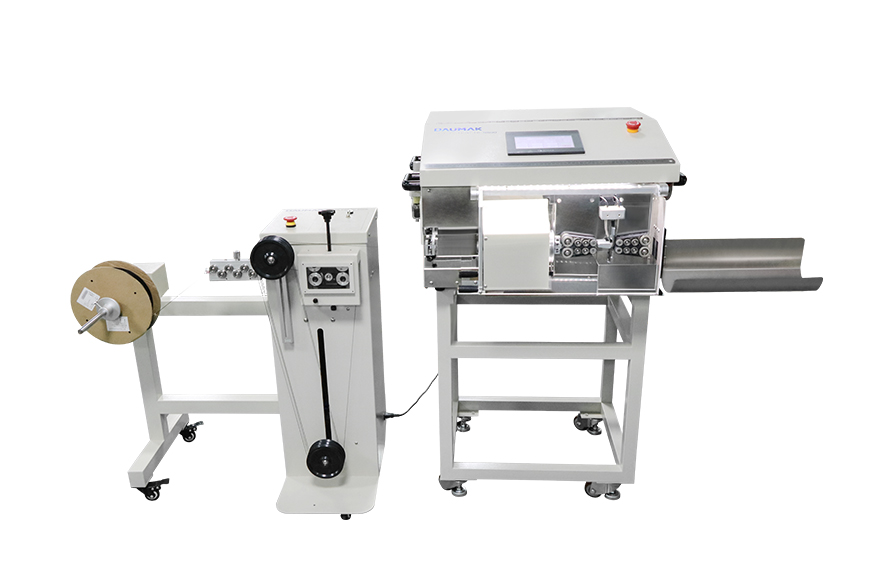
TK-9800 Fully Automatic Coaxial Cable Stripping Machine
Product Overview
The TK-9800 fully automatic coaxial cable stripping machine is an integrated, multi-process automated wire-processing device. It features automatic wire feeding, multi-layer stripping, and cutting functions in one unit, enabling precise processing of coaxial cables ranging from 0.64 to 4 mm in diameter. The machine employs a coordinated working mode that combines wire feeder-driven conveyance, belt transport, rotary cutter rotation for initial cutting, and V-blade sets for peeling, achieving full-process automation in cable processing. This significantly enhances both efficiency and precision, meeting the diverse cable-processing needs of antenna manufacturers, consumer electronics companies, telecommunications equipment producers, medical device makers, and many other industries.
Operating Workflow
The workflow of this stripping machine is clear and seamless. First, the accompanying wire feeder automatically transports the cable, precisely delivering the coaxial wire to the processing station. Next, a belt conveyor system ensures stable transport, keeping the cable steady throughout the process and preventing misalignment or jams. Then, a rotary cutter performs rotational cutting on the cable’s outer layer, preparing it for subsequent peeling operations. Finally, a specialized V-blade set completes multi-layer stripping while simultaneously performing cutting, thus finishing the entire process—feeding, cutting, stripping, and trimming—in one step without requiring manual intervention at multiple stages.
Applicable Cable Specifications
The machine can handle cable diameters from 0.64 to 4 mm, covering most commonly used coaxial cable sizes across various industries. Whether it’s thin-gauge wire used in small consumer electronics or thicker coaxial cables employed in telecommunications and medical devices, the machine delivers precise processing, satisfying the diverse requirements of different sectors.
Core Advantages
1. Fully Automated Operation: Integrating automatic wire feeding, multi-layer stripping, and cutting functions, the machine achieves end-to-end automation, eliminating the need for manual step-by-step handling. This effectively reduces labor costs and boosts overall processing efficiency.
2. Precision Processing Performance: Combining rotary cutter rotation with V-blade peeling ensures accurate cutting and peeling, minimizing damage to the cable and incomplete stripping, thereby maintaining consistent processing quality.
3. Wide Specification Compatibility: Supporting coaxial cables from 0.64 to 4 mm, the machine covers common cable sizes across multiple industries, offering broad applicability without requiring separate equipment for different specifications.
4. Stable Conveyance System: Paired with a belt conveyor, the wire feeder ensures smooth and steady cable transport, preventing misalignment or jams and guaranteeing continuous, reliable processing.
Core Value of the Product
1. Full-process automation dramatically increases cable-processing efficiency, shortens production cycles, and helps enterprises boost output.
2. Precise cutting and peeling processes ensure high-quality results, reduce defect rates, and lower production waste.
3. Broad specification compatibility meets the diverse cable-processing needs of multiple industries, improving equipment utilization and reducing procurement costs.
Target Customer Groups
Antenna manufacturers, consumer electronics producers, telecommunications equipment makers, medical device manufacturers, and professional cable-processing service providers.
Application Scenarios
This machine is primarily used in various applications involving coaxial cable processing. In the antenna manufacturing sector, it handles cutting and stripping of coaxial cables used in antenna assemblies. In consumer electronics, it processes internal coaxial cables found in smartphones, headphones, smart wearables, and similar products. In telecommunications equipment manufacturing, it serves base stations, routers, switches, and other devices requiring coaxial cable processing. In medical device manufacturing, it meets the needs of precision instruments such as monitors and diagnostic equipment, providing efficient, accurate, and automated solutions for cable-processing tasks across industries.
Solving Industry Pain Points
1. Addresses the inefficiency and insufficient capacity of traditional manual cable processing; its fully automated operation can increase processing speed several-fold, meeting the demands of large-scale production.
2. Alleviates issues of inconsistent manual processing accuracy and high defect rates; the machine’s precise cutting and peeling processes ensure uniform quality for every cable, significantly reducing defect rates.
3. Overcomes the limitation of single machines being able to handle only specific cable sizes; with a wide specification range from 0.64 to 4 mm, it accommodates diverse cable types, reducing the need for additional equipment.
4. Prevents cable damage and safety hazards often associated with manual processing; automated operation ensures safe, stable processing while minimizing human-induced cable loss.
Common Questions (FAQ)
Q1: What cable specifications can the TK-9800 fully automatic coaxial cable stripping machine process?
A: This machine can handle coaxial cables ranging from 0.64 to 4 mm in diameter, covering most commonly used sizes across industries and offering strong adaptability.
Q2: What is the machine’s operating workflow?
A: The machine begins with wire feeding by the wire feeder, followed by belt-conveyor transport. After rotary cutter rotation for initial cutting, V-blade sets perform peeling, while simultaneous cutting completes the entire process in one automated cycle.
Q3: Which industries are suitable for using this machine?
A: The machine is well-suited for antenna manufacturers, consumer electronics firms, telecommunications equipment producers, medical device makers, and many other sectors, meeting their respective coaxial cable-processing needs.
Q4: Compared to manual processing, what advantages does this machine offer?
A: The machine provides fully automated operation, higher processing efficiency, consistent precision, lower defect rates, and reduced labor costs along with minimized safety risks during processing.