
 简体中文
简体中文 English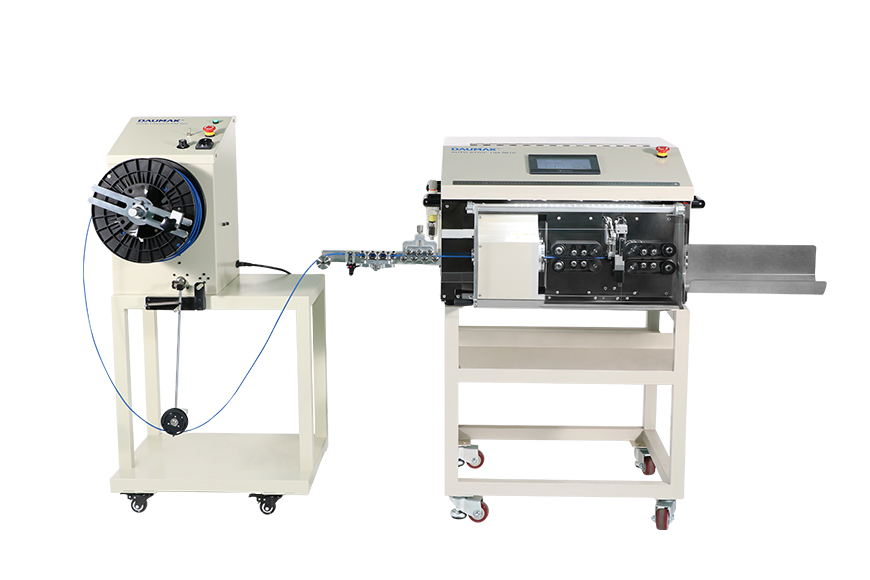
DM-9610S Fully Automatic Coaxial Cable Stripping Machine
Product Overview
The DM-9610S is a fully automatic cable stripping device specifically designed for coaxial cable processing. It integrates three core functions—automatic wire feeding, multi-layer stripping, and wire cutting—and can precisely process coaxial cables ranging from 1 to 6 mm in diameter. The machine employs an integrated workflow that combines wire feeding via a feeder, belt conveyance, rotary cutter-based circumferential cutting, and V-blade stripping, efficiently completing both wire cutting and multi-stage stripping operations with stable precision. It meets the bulk cable-processing needs of antenna manufacturers, consumer electronics companies, and communication equipment producers, providing an automated, standardized solution for cable processing.
Workflow Details
This fully automatic coaxial cable stripping machine features a clear and seamless workflow, enabling fully automated operation from material feeding to finished product output: First, a dedicated wire feeder automatically transports the cable, accurately delivering the coaxial wire to the processing area; next, a belt conveyor system ensures steady transport, keeping the cable precisely positioned without any deviation during processing; then, the rotary cutter initiates circumferential cutting of the outer insulation layer, achieving precise ring‑cutting; afterward, the V‑blade assembly performs multi‑layer insulation stripping according to the cable’s structure; finally, the wire is cut to the preset length, producing finished cables that meet specified dimensions. The entire process requires no manual intervention, significantly enhancing efficiency and consistency in cable processing.
Key Performance Features
1. Fully Automated Operation: Integrating automatic wire feeding, multi‑layer stripping, and wire cutting, this machine eliminates the need for manual handling throughout the process, effectively reducing labor costs, minimizing human error, and boosting processing efficiency.
2. Wide Cable Compatibility: Capable of processing coaxial cables from 1 to 6 mm in diameter, covering most cable specifications used in consumer electronics, communication devices, and antennas, offering broad adaptability.
3. Precision Processing Technology: Combining rotary cutter circumferential cutting with V‑blade stripping, it achieves accurate removal of multiple insulation layers, producing clean, burr‑free cuts and ensuring high‑quality cable processing.
4. Stable Conveyance System: The combination of a wire feeder and belt conveyor ensures consistent cable positioning during processing, preventing misalignment or stretching and improving overall accuracy.
Core Product Value
1. Automation replaces manual labor, dramatically increasing cable‑processing efficiency, shortening production cycles, and meeting the demands of large‑volume orders.
2. Standardized processing procedures ensure consistent precision for every cable, reducing defect rates and enhancing the stability of finished product quality.
3. Broad cable compatibility covers the processing needs of various industries, eliminating the need for additional equipment changes and lowering capital investment.
4. By reducing manual handling steps, the machine lowers worker fatigue while also mitigating potential safety risks associated with manual operations.
Target Customer Base
The DM-9610S fully automatic coaxial cable stripping machine primarily targets enterprises with substantial bulk processing requirements for coaxial cables, including specialized antenna manufacturers, consumer electronics producers, and manufacturers of complete communication equipment and components. It is also suitable for contract processing facilities undertaking outsourced cable‑processing tasks, satisfying the automated cable‑processing needs of diverse businesses.
Application Scenarios
This equipment is mainly used for bulk processing of coaxial cables. In the antenna manufacturing sector, it can handle wire cutting and stripping for various communication antennas, automotive antennas, and other products; in the consumer electronics field, it is well suited for processing internal coaxial cables in smartphones, tablets, Bluetooth headsets, and similar devices; and in the communications equipment manufacturing industry, it supports cable‑processing stages for base stations, routers, switches, and other equipment, providing reliable cable‑processing support for the production of diverse electronic products.
Solving Industry Pain Points
1. Addressing low efficiency and limited capacity of manual stripping: Manual stripping is not only slow but also prone to reduced productivity due to operator fatigue, whereas the fully automatic machine can operate continuously around the clock, increasing throughput several times over.
2. Improving poor processing accuracy and high defect rates: Manual stripping struggles to maintain consistent stripping lengths and cut smoothness across individual cables, leading to higher defect rates, while the machine’s standardized mechanical processes deliver stable precision and significantly lower defect rates.
3. Tackling the challenge of multi‑layer stripping: Coaxial cables often feature complex multi‑layer structures, making it difficult for manual methods to precisely remove each insulation layer; the machine’s rotary cutter combined with V‑blade assembly enables accurate multi‑layer stripping, meeting the demands of intricate cable designs.
4. Reducing labor and management costs: Adopting automated equipment decreases the number of frontline operators, lowering labor expenses, while also simplifying administrative processes.
Frequently Asked Questions (FAQ)
Q1: What cable diameters can this stripping machine process?
A: The DM-9610S fully automatic coaxial cable stripping machine can handle coaxial cables ranging from 1 to 6 mm in diameter, covering most common cable specifications used in consumer electronics, communication devices, and antennas.
Q2: What is the machine’s operating workflow?
A: The machine begins with automatic wire feeding by a feeder, followed by belt conveyance to the processing zone. First, the rotary cutter performs circumferential cutting of the outer insulation layer, then the V‑blade assembly completes multi‑layer stripping, concluding with wire cutting—all fully automated.
Q3: Which industries are best suited to use this equipment?
A: This machine is particularly well suited for antenna manufacturers, consumer electronics producers, and communication equipment makers, meeting their needs for automated bulk processing of coaxial cables.
Q4: What benefits does using this equipment bring?
A: Using this machine greatly enhances cable‑processing efficiency, ensures consistent processing accuracy, reduces defect rates, and simultaneously lowers labor costs and worker fatigue, thereby improving overall production performance.