
 简体中文
简体中文 English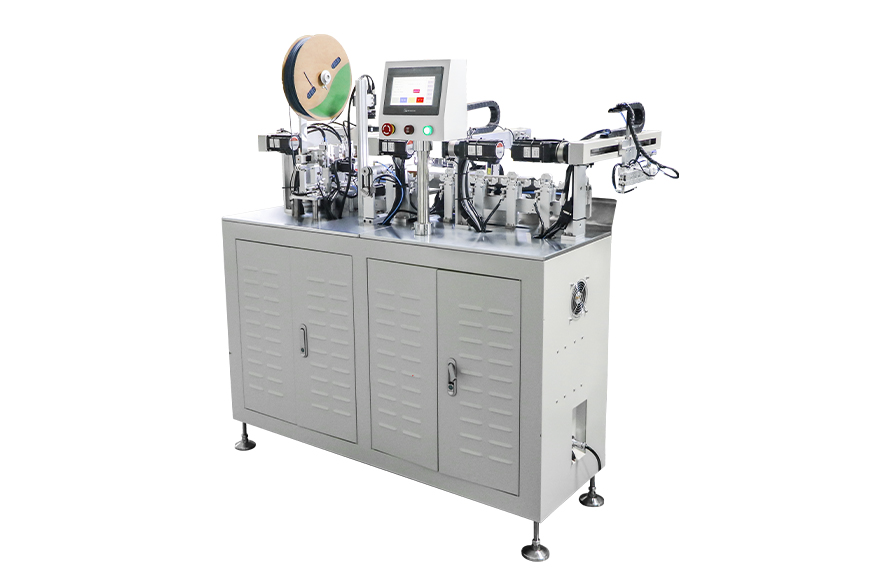
Automatic Heat-Shrink Tube Insertion Machine DM-D0113
Product Overview
The automatic heat-shrink tube insertion machine DM-D0113 is a fully automated device specifically designed for the back-end production of RF connectors. It seamlessly interfaces with front-end terminal-pressing and tinning machines as well as back-end soldering equipment, forming a complete automated production line for RF connectors. The machine can independently perform the entire process, including automatic inkjet coding (optional), automatic cutting of heat-shrink tubes, automatic insertion of heat-shrink tubes, industrial vision inspection, terminal crimping angle adjustment, and automatic baking of heat-shrink tubes—without any manual intervention. This significantly enhances both production efficiency and processing accuracy in the heat-shrink tube insertion stage for RF connectors, making it a core automated production support system for the consumer electronics and telecommunications industries.
Core Process Flow
This automatic heat-shrink tube insertion machine features a modular, fully automated design that comprehensively covers all steps involved in inserting heat-shrink tubes onto RF connectors. First, it seamlessly connects to front-end terminal-pressing and tinning machines, receiving RF connector components completed in the preceding process. Next, an optional automatic inkjet coding module can be added to mark each component according to production requirements. Then, the machine precisely cuts the heat-shrink tubes to match the specific dimensions of the RF connectors. Following this, the heat-shrink tubes are automatically inserted, ensuring precise alignment between the tubes and the connectors. An industrial vision inspection module continuously monitors insertion accuracy in real time, guaranteeing high-quality output. Subsequently, the terminal crimping angle is adjusted to meet the process requirements of subsequent soldering operations. Finally, automatic baking secures the heat-shrink tubes tightly, completing the entire heat-shrink tube insertion process. The entire workflow requires no manual intervention, ensuring smooth production and consistent processing precision.
Key Adaptability Features
1. Seamless Front-to-Back Integration: The machine precisely interfaces with front-end terminal-pressing and tinning equipment, directly receiving RF connector components finished in the previous step. It also accommodates connection to back-end soldering and other production machinery, enabling a fully automated production chain from terminal pressing and tinning through heat-shrink tube insertion to final soldering—eliminating errors and efficiency losses associated with manual handling.
2. Comprehensive Automation Coverage: From heat-shrink tube cutting and insertion to inspection and baking, all critical processes are performed without human involvement, effectively reducing operator-induced variability and improving production consistency and product quality rates.
3. Flexible Optional Features: With the option to add automatic inkjet coding, the machine can easily incorporate component marking functions tailored to specific production needs, meeting diverse customer requirements for traceability and identification.
4. Professional Vision Inspection Assurance: Equipped with an industrial vision inspection module, the machine continuously monitors key parameters such as heat-shrink tube insertion position and angle, promptly identifying and rejecting non-conforming parts to ensure high processing accuracy.
Core Advantages
1. Enhanced Production Efficiency: Compared to manual operations, the fully automated workflow dramatically shortens the processing time per component, boosting throughput per unit time and meeting the large-scale production demands of the consumer electronics and telecommunications sectors.
2. Guaranteed Processing Accuracy: The combination of automated mechanical systems and industrial vision inspection ensures consistent dimensions for heat-shrink tube cuts, insertion positions, and terminal angles, eliminating random errors inherent in manual operations and enhancing product quality stability.
3. Reduced Labor Costs: By minimizing human involvement in the heat-shrink tube insertion process, companies lower labor expenses while avoiding safety risks associated with manual handling.
4. Closed-Loop Production Chain: Seamlessly connecting front-end and back-end production equipment, the machine establishes a complete automated production flow, elevating overall operational intelligence and reducing time and manpower wasted on intermediate transfers.
Target Customer Groups
RF connector manufacturers in the consumer electronics industry, telecommunications equipment producers, RF connector module processors, automated electronic component suppliers, and large-scale electronics contract manufacturers.
Application Scenarios
This automatic heat-shrink tube insertion machine is primarily used in the RF connector production stages of the consumer electronics and telecommunications industries. Specific application scenarios include mass production of RF connectors for consumer electronics, processing of RF connectors for communication base stations, supporting assembly of RF connectors for RF modules, and integration into automated electronic component production lines. Whether handling a single RF connector heat-shrink tube insertion task or establishing a complete automated production line, the machine provides stable performance and meets production needs across various scales.
Solving Industry Pain Points
1. Addressing Low Efficiency and Insufficient Capacity in Manual Heat-Shrink Tube Insertion: Manual operations require lengthy processing times per component, making it difficult to meet the high-volume production demands of the industry. The machine’s fully automated operation significantly boosts productivity, breaking through capacity bottlenecks.
2. Improving Unstable Manual Processing Accuracy: Human error often leads to deviations in heat-shrink tube cutting, inaccurate insertion positions, and inconsistent terminal angles, resulting in low product yield. The machine’s automated mechanisms combined with visual inspection ensure consistent processing accuracy, thereby increasing finished-product pass rates.
3. Bridging Gaps in the Production Chain: In traditional production models, front-end terminal pressing and tinning, mid-stage heat-shrink tube insertion, and back-end soldering are typically performed separately, requiring manual transfers that can damage components and waste time. The machine seamlessly integrates front-end and back-end equipment, closing the production loop and enhancing overall efficiency.
4. Reducing Safety Risks Associated with Manual Operations: High-temperature baking of heat-shrink tubes poses significant safety hazards, with potential for accidents during manual handling. The machine’s automated baking process eliminates the need for human intervention, effectively mitigating these risks.
Frequently Asked Questions (FAQ)
Q1: Can the automatic heat-shrink tube insertion machine DM-D0113 interface with existing production equipment?
A: Yes, the machine seamlessly connects to front-end terminal-pressing and tinning equipment and also supports interfacing with back-end soldering and other production machinery. It is compatible with most existing RF connector production lines, requiring no major modifications to current production facilities.
Q2: Does the machine support RF connectors of different specifications?
A: The machine can adjust parameters such as heat-shrink tube cut lengths and insertion positions based on the specific dimensions of the RF connectors, accommodating a wide range of sizes for heat-shrink tube insertion tasks.
Q3: Is automatic inkjet coding a mandatory configuration?
A: Automatic inkjet coding is an optional feature; customers may choose whether or not to add it according to their own traceability and labeling needs, without affecting the machine’s core heat-shrink tube insertion process.
Q4: How does the machine ensure processing accuracy?
A: The machine employs automated mechanical systems to achieve precise cutting and insertion, while an industrial vision inspection module continuously monitors processing parameters in real time, ensuring that heat-shrink tube insertion positions, terminal angles, and other critical dimensions comply with process requirements, thus safeguarding finished-product accuracy.