
 简体中文
简体中文 English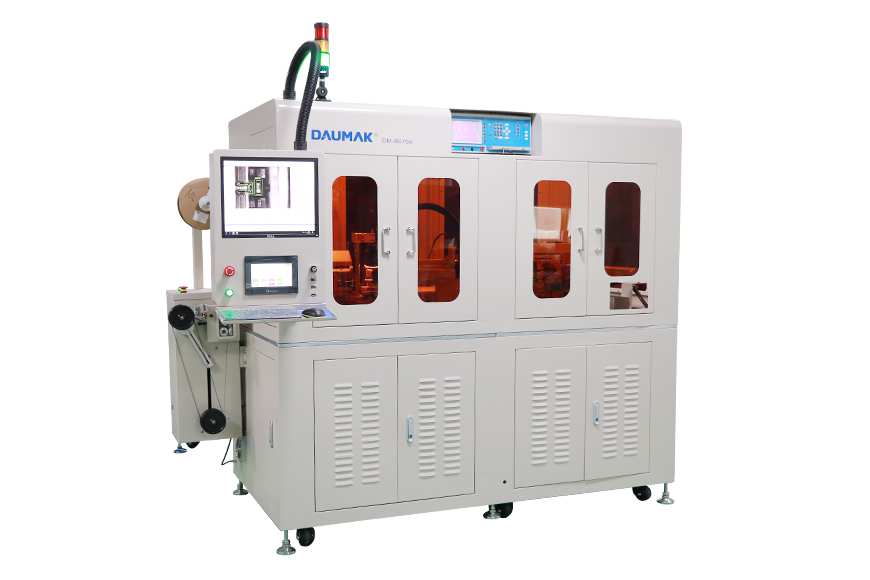
DM-B0706 Fully Automatic Coaxial Cable End-Terminating and Tin-Plating Machine
Product Overview
The DM-B0706 fully automatic coaxial cable end-terminating and tin-plating machine is a comprehensive, process‑level automated production device specifically designed for RF connector manufacturing. It covers the entire production workflow, from raw material feeding to finished product sorting. The equipment integrates core functions such as automatic wire feeding, stripping, cutting, terminal crimping, electrical testing, and tin plating, while also featuring automatic identification and sorting of defective parts. It can replace traditional manual operations, significantly improving both production efficiency and quality stability for RF connectors. Through multiple generations of technological refinement, the machine has achieved steady improvements in yield and output, while maintaining ease of operation and convenient maintenance, making it well suited to the large-scale production needs of consumer electronics, telecommunications equipment, and other industries.
Core Technology Integration
This model incorporates several advanced automation technologies to deliver an integrated solution for RF connector production. First, it is equipped with a precision coaxial cable stripper that ensures accurate and consistent cable stripping dimensions, meeting the stringent precision requirements of RF connector manufacturing. Second, a robotic system is employed to handle material transfer and positioning between processes, enabling seamless transitions and minimizing errors and efficiency losses associated with manual handling. Additionally, high-resolution vision technology is integrated to perform real-time visual inspection of critical stages during processing, accurately identifying defects and providing reliable data for subsequent sorting of nonconforming parts.
In addition to these core technologies, the machine also features automatic crimping, automated electrical testing, automatic flux application, and automatic soldering. The automatic crimping function ensures precise connection between terminals and cables, guaranteeing strong and stable electrical performance. Automated electrical testing allows for timely detection of products failing to meet electrical specifications. Meanwhile, automatic flux application and soldering automate the welding process, ensuring consistent weld quality and eliminating issues like cold joints or incomplete soldering that often arise with manual methods.
Core Function Details
1. Full‑Process Automation: Starting from feeding the coaxial cable, the machine automatically completes all key steps—including cutting, stripping, terminal crimping, electrical testing, and tin plating—without requiring manual intervention at any stage. This achieves fully automated RF connector production, dramatically shortening the production cycle and increasing output per unit time.
2. Automatic Defective Part Sorting and Collection: Utilizing a dual‑mode judgment system combining electrical testing and visual inspection, the machine precisely identifies defective parts during processing and automatically sorts them into separate collection bins, preventing substandard components from entering downstream stages and reducing labor‑intensive sorting costs and error rates.
3. Multi‑Generation Iterative Optimization: Through successive technological upgrades, the machine has consistently improved both yield and throughput, significantly reduced the incidence of malfunctions, and streamlined its user interface and maintenance design, making daily operation and routine upkeep more convenient and lowering the technical skill requirements for operators.
Key Advantages
1. Enhanced Production Efficiency: With its fully automated workflow, this machine outperforms traditional manual production by substantially boosting productivity, reducing waiting times and human‑induced errors, and meeting the high-volume demands of large‑scale manufacturing.
2. Consistent Product Quality: Leveraging precision stripping, visual inspection, automated testing, and other advanced technologies, the machine ensures accuracy and consistency across every processing step, greatly improving product yield and minimizing defects caused by human error.
3. Convenient Operation and Maintenance: After multiple rounds of optimization, the machine’s user interface is intuitive and easy to learn, allowing operators to quickly become proficient after minimal training. Its maintenance structure is thoughtfully designed, making routine upkeep and troubleshooting more efficient and reducing downtime.
4. Comprehensive Process Coverage: Covering the entire production chain—from cable feeding to finished product sorting—the machine eliminates the need for additional auxiliary equipment, saving workshop space and simplifying production management.
Core Value Proposition
1. Replaces manual production, reducing labor costs and minimizing quality fluctuations caused by human error, thereby enhancing production stability and controllability.
2. Increases production efficiency and product yield, helping companies expand capacity, fulfill market orders, and strengthen their competitive edge.
3. Simplifies production workflows, reduces equipment requirements, optimizes plant layout, and improves space utilization and operational efficiency.
Target Customer Base
RF connector manufacturers, consumer electronics producers, telecommunications equipment makers, precision electronic component processors, and automation equipment integrators.
Application Scenarios
This equipment is primarily used in the RF connector production segments of the consumer electronics and telecommunications industries, suitable for large‑scale manufacturing scenarios involving high volumes of RF connectors, including smartphone RF connector assembly, base station communication equipment connector production, consumer wireless device component fabrication, and precision electronic instrument connector processing. Whether for small‑batch pilot runs or full‑scale mass production, the machine provides a reliable, efficient, and highly precise automated solution.
Addressing Industry Pain Points
1. Resolves the inefficiencies of traditional manual production, where low processing speeds and insufficient yields fail to meet large‑order demands, by dramatically increasing output per unit time through full automation.
2. Mitigates the issue of fluctuating product quality and high defect rates caused by manual operations, ensuring consistent and stable product quality through precision technologies and rigorous inspection mechanisms.
3. Tackles the complexity and high labor costs associated with fragmented manual processes requiring multiple machines and operators, by integrating all steps into a single, unified system that streamlines workflows and reduces management overhead and manpower expenses.
4. Prevents common quality problems arising from manual soldering and terminal crimping, such as cold joints and loose connections, thereby enhancing the overall reliability and service life of RF connectors.
Common Questions (FAQ)
Q1: What processes can the DM‑B0706 fully automatic coaxial cable end‑terminating and tin‑plating machine perform?
A: This machine handles the complete workflow, including automatic wire feeding, stripping, cutting, terminal crimping, electrical testing, and tin plating. It also features automatic sorting of defective parts and separate collection of good and defective items, enabling the full processing of RF connectors without the need for additional equipment.
Q2: Is the machine difficult to operate?
A: Following multiple rounds of technological optimization, the machine’s user interface is simple and intuitive; operators can quickly master its functions after brief training. Daily operation is straightforward, and the maintenance design has been refined to make troubleshooting and routine upkeep easier.
Q3: Which industries does this equipment primarily serve?
A: Designed specifically for RF connector manufacturing, the machine is best suited to the consumer electronics and telecommunications sectors, applicable to various large‑scale RF connector production scenarios.
Q4: How does this machine compare to manual production?
A: Compared to manual methods, the machine significantly boosts production efficiency, ensures consistent and stable product quality, lowers defect rates, and reduces labor and management costs.